I'm an Obesity MD and Here's What Really Happens to Your Muscles After 6 Months on Ozempic


Weight-loss drugs like Ozempic have become increasingly popular—for good reason. They deliver real results. When paired with healthy lifestyle interventions—like a nutritious diet and sufficient sleep—weight-loss meds help patients get into great shape. That said, muscle loss is a common concern when on a weight-loss journey. So, we spoke with Dr. Fernando Ovalle Jr., double board-certified plastic surgeon and obesity medicine specialist, who shares what really happens to your muscles after six months on Ozempic.
How GLP-1s Impact Muscle Tissue
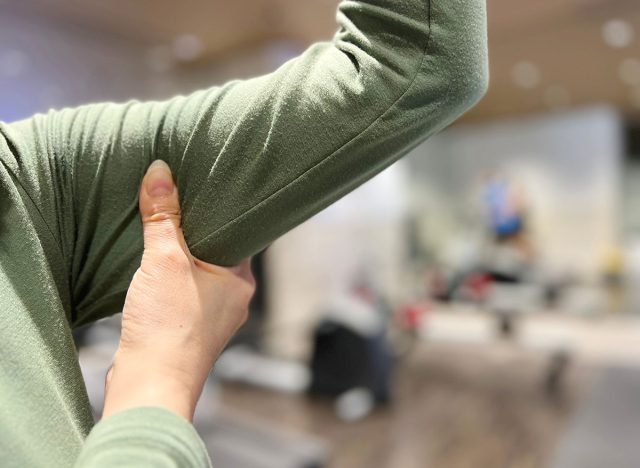
"After six months on a GLP-1 like Ozempic, most patients experience a decrease in both fat mass and lean mass, but the proportion of lean mass loss is typically similar to what we see with diet-induced weight loss," Dr. Ovalle Jr. shares.
While your muscles technically won't "shrink away," they channel the reduction in glycogen stores, intramuscular fat, and mechanical demands. This is because those on weight-loss drugs usually consume fewer calories and don't exercise as much.
"When patients follow structured protein and resistance-training plans, we can preserve the majority of their lean mass," Dr. Ovalle Jr. explains.
Which muscles are impacted the most? The bigger postural and lower-body muscles, including the hamstrings, quads, and glutes, because they handle the majority of your body weight.
"When weight decreases rapidly and activity decreases simultaneously, these muscles lose some of their daily mechanical load. Upper-body muscles tend to change less unless overall protein intake is very low or the patient is more severely deconditioned," Dr. Ovalle Jr. says.
RELATED: 11 Things This Doctor Wants You to Know Before Taking Ozempic
What Actually Causes Muscle Loss When Taking Weight-Loss Drugs
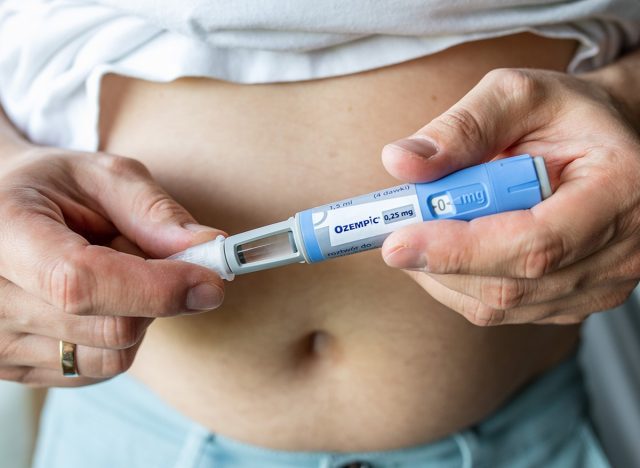
GLP-1s are appetite suppressants, so patients naturally eat fewer meals and typically less protein than their body requires.
"When intake drops below the threshold needed to maintain muscle turnover, the body mobilizes not only fat but also some lean tissue," Dr. Ovalle Jr. says. "The medication itself is not toxic to muscle; the loss reflects energy imbalance and lower anabolic signaling."
Muscle loss is mainly driven by the calorie deficit and insufficient protein intake rather than Ozempic itself.
"GLP-1s simply make it easier for patients to eat less. If someone takes Ozempic but maintains their protein intake and stays physically active, we see minimal and clinically acceptable lean-mass loss," Dr. Ovalle Jr. explains. "Conversely, a patient who dramatically restricts calories or avoids eating due to nausea will lose more lean mass regardless of the medication."
RELATED: 10 GLP-1 Medication Lies You Should Stop Believing, Says Nurse
How Strength Changes During the First Six Months

Compared to muscle volume, strength typically declines at a slower rate. Early on in the process, you might feel a bit weaker due to lower energy intake rather than experiencing actual muscle loss.
"However, with consistent resistance training—even just two to three days a week—most patients maintain or even improve strength, despite modest reductions in muscle mass. Strength preservation is very achievable with proper guidance," Dr. Ovalle Jr. says.


